
Slim Tactile Exit Signs: Space-Saving Compliance for Australian Builders

A single non-compliant sign on a narrow architrave can stall a multi-million dollar project handover. You understand that meeting the rigid mandates of the National Construction Code (NCC) 2025 often creates a conflict between architectural intent and regulatory necessity. Bulky, standard-sized signage frequently clashes with modern minimalist interiors or simply won't fit the spatial constraints of contemporary door frames. It's a common point of friction that leads to failed final inspections and costly delays.
Choosing slim tactile exit signs ensures your project remains 100% compliant without compromising on design. This article explores how these specialised signs meet the strict requirements of AS 1428.1:2021 and AS/NZS 2293.1 while fitting into the tightest architectural footprints. We'll detail the essential technical specifications, including the 30% luminance contrast (LRV) required for accessibility and the precise "Exit Level" wording needed for specific floor heights. You'll learn how to source durable, Australian-made signage that satisfies auditors and meets your fast-tracked construction deadlines.
Key Takeaways
- Learn how slim tactile exit signs resolve the conflict between narrow architraves and strict NCC spatial requirements.
- Identify the specific wording requirements under NCC Specification 15 for multi-level buildings to avoid inspection failures.
- Evaluate material choices between cost-effective polypropylene and high-durability metallic finishes for different egress environments.
- Ensure 100% compliance by applying correct installation heights and latch-side positioning as mandated by AS 1428.1:2021.
- Streamline your project timeline by sourcing technical signage directly from an Australian manufacturer with custom fabrication capabilities.
Understanding Slim Tactile Exit Signs for Modern Australian Buildings
Slim tactile exit signs are engineered safety components featuring a reduced-width profile. They're designed specifically for installation on narrow mounting surfaces where standard signage dimensions are impractical. Modern Australian architecture often prioritizes minimalist aesthetics and slim structural elements. This design trend leaves builders with limited clearance on architraves, mullions, and structural columns. These specialized signs solve the conflict between architectural intent and safety regulations.
Tactile and braille elements are mandatory for emergency egress under the National Construction Code (NCC). These features ensure an Exit sign is accessible to individuals with vision impairment. Slim tactile exit signs maintain the legally required character heights and braille cell dimensions while significantly reducing the vertical or horizontal footprint. This allows for compliance in spaces that previously required bulky, overhanging signage.
Spatial Constraints in Commercial Fit-outs
Commercial interiors frequently feature narrow door frames and tight structural cavities. Standard signage often overhangs these surfaces, creating a snag hazard or failing aesthetic reviews. Minimalist designs require signs that integrate seamlessly without causing visual clutter. AS 1428.1 mandates clear paths of travel; slim signs help maintain these clearances by staying within the narrow bounds of the door architrave. This prevents the sign from protruding into the path of travel or clashing with high-end finishes.
The Difference Between Standard and Slim Profiles
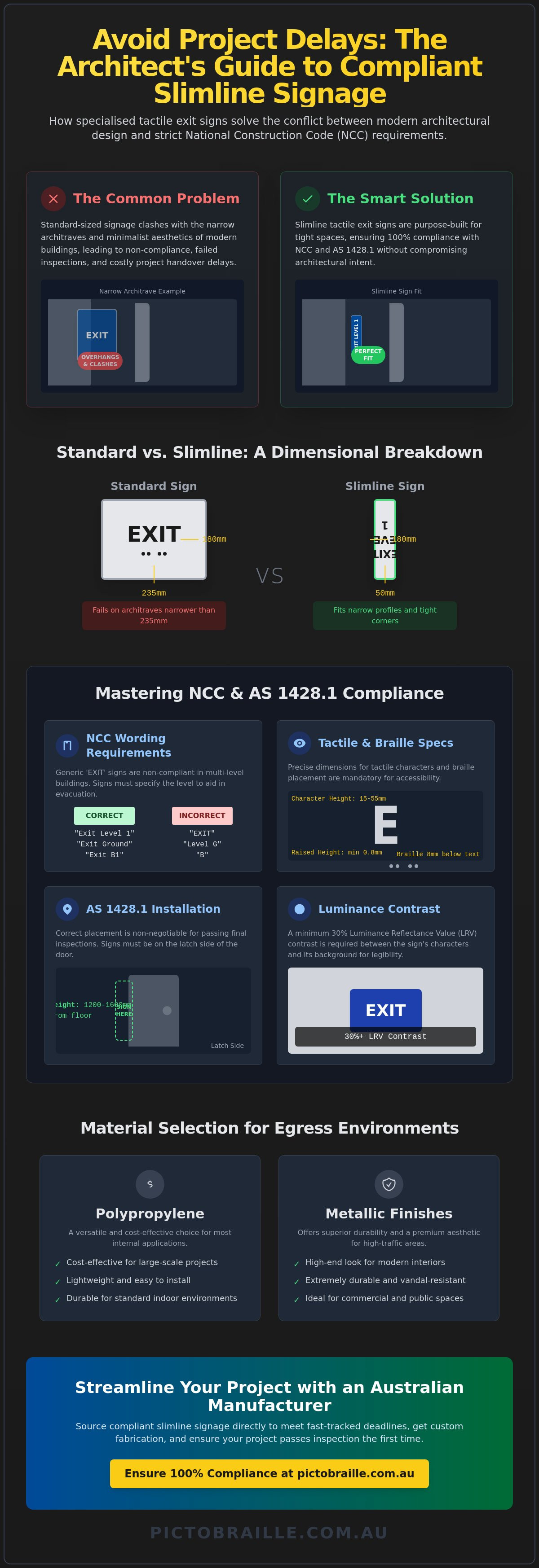
Dimensional differences are the primary distinction between these formats. A standard tactile sign often measures approximately 180mm x 235mm. In contrast, a slim profile typically utilises a 180mm x 50mm format. This condensed layout requires expert manufacturing to maintain correct braille cell spacing and tactile character separation. While the footprint is smaller, functional readability remains high due to high-contrast finishes and precise lettering.
Compliance isn't just about presence; it's about placement. When a doorway is positioned close to a corner or a perpendicular wall, a standard sign won't fit on the latch side. Slim profiles provide the necessary flexibility to meet the latch-side requirement without requiring structural modifications. This precision prevents the common issue of failing a final inspection due to signage overhanging a door opening or being placed too far from the egress point. These signs are functional solutions for high-density commercial fit-outs where every millimetre of wall space is accounted for.
Meeting NCC Specification 15: The "Exit Level" Requirement
NCC Specification 15 dictates the exact requirements for braille and tactile signage in Australian buildings. For multi-level structures, a generic "EXIT" sign is often a compliance breach. The Australian Building Codes Board (ABCB) requires that signs identify the specific level to assist people with vision impairment during an evacuation. This is where slim tactile exit signs become essential. They provide the necessary "Exit Level" information while fitting onto the narrow architraves common in modern stairwells.
The regulation is precise. Tactile characters must have a height between 15mm and 55mm. Braille must be located 8mm below the bottom line of the tactile text. If the sign uses multiple lines, the braille follows the final line. Failing to maintain these exact clearances will result in a failed building audit. Precision in manufacturing is required to ensure these elements fit within a slim profile without crowding the tactile components.
Correct Wording for Compliance
Clarity is the priority for emergency egress. Use "Ground" or "Level G" rather than an ambiguous "G" alone. For upper floors, "Level 1" or "Level 2" is the standard. Basement levels require "Basement 1" or "B1" to ensure there's no confusion during a high-stress exit scenario. Plant rooms and mezzanine levels must also be clearly identified. A common mistake is installing a sign that only says "EXIT" at a fire stairs entry on an upper floor. This lacks the level identification required by the NCC. You can find fully compliant wording options in our standard range to avoid these errors.
Tactile and Braille Specifications
Tactile elements must be raised at least 0.8mm from the base surface. This ensures they're easily identifiable by touch. Braille must be Grade 1 uncontracted Australian Braille. The finish of the raised elements is also regulated. They must be "soft to touch" with rounded edges. This prevents injury to the user's fingers and ensures the braille is readable. Sharp edges from poor-quality engraving or 3D printing can lead to non-compliance. High-quality slim tactile exit signs use specialised manufacturing processes to create smooth, durable characters that withstand heavy use in high-traffic commercial zones.
Compliance is non-negotiable. Every element, from the letter height to the braille spacing, must align with the current NCC 2025 standards. Builders who overlook these details risk significant project delays during the final certification phase. Selecting the correct wording and material at the procurement stage is the most efficient way to guarantee a pass during the final inspection.
Material Selection: Polypropylene vs Metallic Slim Signage
Material choice is a critical decision for builders. It impacts both the project budget and the long-term durability of the safety system. Slim tactile exit signs must withstand frequent cleaning, UV exposure, and accidental impact in high-traffic egress routes. Polypropylene remains the Australian industry standard for these applications. It's a robust, non-corrosive polymer that provides superior longevity compared to acrylic alternatives, which are prone to cracking in industrial environments.
The National Construction Code (NCC) requires that signage remains legible and securely attached for the life of the building. Polypropylene's lightweight profile facilitates this. It allows for high-bond adhesive installation on narrow surfaces where mechanical fixing is impossible or architecturally undesirable. For projects requiring specific aesthetic integration, polypropylene is available in blue, silver, charcoal, and black finishes.
Why Polypropylene Dominates the Market
Polypropylene is impervious to most chemical cleaners. This is essential for healthcare and educational facilities where rigorous sanitisation is standard. The material's flexibility prevents shattering upon impact, a common failure point for rigid plastic signs. In-house manufacturing of these signs allows for rapid customisation. Builders can source specific "Exit Level" identifiers with minimal lead times. This speed is vital when a project is approaching the final inspection phase and signage gaps are identified.
Metallic Finishes for Architectural Integration
Anodised aluminium is the preferred specification for industrial egress points or outdoor environments. The anodising process creates a surface that is resistant to scratching and saltwater corrosion. For high-end commercial lobbies or corporate fit-outs, stainless steel offers a premium aesthetic. These metallic options allow architects to match slim tactile exit signs with existing door hardware, handrails, and lighting fixtures.
Maintaining tactile integrity is a technical challenge in metallic fabrication. The raised characters and braille dots must be permanently bonded or embossed to prevent delamination. High-quality metallic signs use precision engineering to ensure the tactile elements meet the 0.8mm height requirement mandated by Australian standards. While polypropylene offers the best value and versatility, metallic finishes provide the durability required for the most demanding architectural specifications. Choosing the correct material at the procurement stage prevents premature wear and ensures the building remains compliant for years to come.
Installation Standards: Passing Your Final Building Inspection
Compliance at the final inspection stage depends on precise physical placement. AS 1428.1:2021 mandates that tactile characters must be positioned between 1200mm and 1600mm above the finished floor level. For single-line slim tactile exit signs, the industry standard is to centre the characters at 1250mm to 1350mm. This ensures consistent accessibility for all users. Incorrect height is one of the most frequent reasons for a failed building audit.
Latch side placement is the primary rule for exit signage. The sign must be located on the wall adjacent to the door handle or latch. If the latch side lacks sufficient wall space, the sign must be placed on the nearest adjacent wall. Using a slim profile allows you to maintain the latch-side requirement on narrow architraves where a standard sign simply won't fit. You must also adhere to the "Two-Finger" rule; the sign should be positioned within 50mm of the door frame to ensure it's easily located by touch.
Achieving Required LRV Contrast
Luminance contrast of at least 30% is a mandatory requirement between the sign and the mounting surface. This contrast ensures visibility for individuals with low vision during emergency egress. You must select your sign colour based on the Light Reflectance Value (LRV) of the wall. For light-coloured walls, charcoal or black backgrounds are effective. For dark or metallic surfaces, silver or white lettering on a blue background provides the necessary definition. You can order compliant signage in various colours to suit any architectural finish while meeting these safety standards.
Mounting on Narrow Architraves
Slim signs are specifically engineered for 50mm door frames and mullions. Installation requires precision to ensure the sign does not interfere with door operation or acoustic seals. High-bond double-sided tape is the preferred method for permanent adhesion on these narrow surfaces. It provides a clean finish without the need for mechanical fasteners that might damage the frame. Before application, ensure the surface is de-greased and dry. A secure, flush-mounted sign prevents snagging and ensures the safety system remains intact under heavy commercial use.
Precision in installation is as important as the sign's construction. Auditors look for exact measurements and high-contrast visibility. By combining slim tactile exit signs with correct mounting techniques, builders can navigate the complexities of AS 1428.1 without requiring costly structural modifications. Ensuring these standards are met during the initial fit-out prevents the delays and expenses associated with post-inspection rectifications.
Sourcing Slimline Signage Direct from the Australian Manufacturer
Sourcing slim tactile exit signs directly from an Australian manufacturer eliminates the risks associated with third-party resellers or imported products. Pictobraille manages the entire production cycle in-house. This ensures every sign adheres to the precise technical measurements required for NCC 2025 compliance. Local manufacturing allows for the creation of non-standard level indicators that generic suppliers cannot provide. If your project includes a "Mezzanine", "Rooftop", or "Plant Room", custom fabrication is the only way to ensure the wording matches your specific architectural plans.
Large-scale high-rise developments require hundreds of level-specific identifiers. Bulk ordering directly from the source ensures consistency in material finish and tactile quality across the entire site. We provide national shipping to meet the fast-paced deadlines of major Australian construction projects. Wherever your project is located across the nation, technical signage arrives ready for immediate installation. This direct-to-builder model reduces costs and provides a clear line of accountability for safety auditors.
In-House Production Benefits
Direct control over manufacturing translates to superior quality assurance. We monitor braille cell dimensions and tactile character heights to the millimetre. This precision prevents the common issue of tactile elements delaminating or falling below the 0.8mm minimum height. Direct communication with the manufacturer allows builders to clarify technical specifications before production begins. This eliminates the confusion often found with imported signs that may use international braille standards instead of the Grade 1 uncontracted braille required in Australia. Reduced lead times are a standard benefit of local production, ensuring your project doesn't stall while waiting for overseas shipments.
Ordering Your Slim Exit Signs
A fact-first approach to procurement prevents project delays. Builders should start by cross-referencing their signage schedule with the latest NCC requirements. This ensures every egress point has the correct level identifier. Before placing a wholesale order, verify the following specifications:
- Confirm the mounting surface width to ensure a slim profile is required.
- Identify the wall LRV to select the correct background colour for 30% contrast.
- List every unique level identifier, including basements and mezzanines.
- Specify the preferred material, such as polypropylene, anodised aluminium, or stainless steel.
Our slim tactile exit signs are supplied with high-bond double-sided tape already applied. This makes the transition from delivery to installation seamless. By sourcing directly from a master manufacturer, you gain a partner who understands the intricacies of Australian safety law. This technical expertise provides the peace of mind that your project will pass audit without the need for costly signage replacements or secondary inspections. Reliable compliance is the result of precision manufacturing and adherence to industry standards.
Secure Your Final Building Approval with Compliant Signage
Compliance with NCC 2025 and AS 1428.1:2021 is a non-negotiable requirement for successful project handover. You've identified how precise "Exit Level" identification and 30% luminance contrast prevent costly inspection failures. Slim profiles solve the spatial constraints of modern architraves and narrow mullions without compromising on mandatory tactile or braille standards. Investing in slim tactile exit signs ensures your project meets all accessibility mandates while maintaining a clean, minimalist architectural finish.
Pictobraille provides technical signage that is 100% NCC and AS1428.1 compliant. Every sign is manufactured in-house by The Shape Makers to ensure exact braille cell dimensions and tactile character heights. Our products are supplied with high-bond double-sided tape for immediate, permanent installation on-site. This direct-to-manufacturer approach guarantees technical accuracy and fast turnaround times for high-density developments. Order NCC-compliant slim tactile exit signs direct from Pictobraille today to streamline your final certification process. Your project remains in safe hands with our precision-engineered safety solutions.
Frequently Asked Questions
What is the minimum size for a compliant tactile exit sign in Australia?
There's no single mandated minimum plate size, but the tactile elements must comply with AS 1428.1 dimension standards. Tactile characters must be between 15mm and 55mm in height, with braille positioned 8mm below the text. Slim tactile exit signs typically utilise a 180mm x 50mm footprint to maintain these technical requirements while fitting narrow architraves.
Do slim tactile exit signs need to include the word "Level"?
Yes, multi-level buildings require the sign to state "Exit Level" followed by the floor number or letter. A generic "EXIT" sign is insufficient for multi-storey egress points under NCC Specification 15. This specific wording assists vision-impaired users in identifying their exact location within the building during an emergency evacuation.
Can I install a slim exit sign directly on the door instead of the wall?
Installation must be on the wall on the latch side of the door wherever possible. AS 1428.1 requires the sign to be fixed to the wall to ensure it remains in a predictable location for touch-based navigation. Installing directly on a door is generally non-compliant as the sign's position changes when the door is opened.
What is the required mounting height for braille exit signage under the NCC?
Mandatory mounting height for tactile and braille characters is between 1200mm and 1600mm above the finished floor level. For consistency, most auditors prefer the centreline of the tactile text to be positioned between 1250mm and 1350mm. This range ensures the sign is accessible to the widest demographic of users, including those in wheelchairs.
How do I calculate the luminance contrast for a slim exit sign?
Luminance contrast is calculated by comparing the Light Reflectance Value (LRV) of the sign's background with the LRV of the mounting surface. A minimum 30% contrast is required under AS 1428.1. You can achieve this by selecting a high-contrast colour pairing, such as a black sign on a light-coloured wall or a silver sign on a dark charcoal surface.
Are slim polypropylene exit signs suitable for outdoor use?
Polypropylene is highly suitable for outdoor egress points due to its UV stability and non-corrosive properties. It resists chemical cleaners and environmental degradation better than many acrylic alternatives. For extreme industrial or coastal environments, anodised aluminium or stainless steel options provide additional durability and resistance to salt spray.
Do I need a different sign for an "Accessible Exit"?
Yes, if the exit is part of a designated accessible path of travel, it must include the International Symbol of Access (ISA). This identifies the route as suitable for people with disabilities. Standard exit signs and accessible exit signs serve different functional purposes and must be specified correctly in your signage schedule.
Can Pictobraille manufacture custom level numbers for slim signs?
Yes, Pictobraille provides custom fabrication for all level identifiers, including non-standard designations like "Mezzanine", "Rooftop", or "Basement 2". All custom slim tactile exit signs are manufactured in-house to ensure they meet the same 100% NCC compliance standards as our stock range. Direct manufacturing allows for rapid turnaround on these specific project requirements.