
Essential Hospital Braille Signage: A Guide to Healthcare Compliance 2026
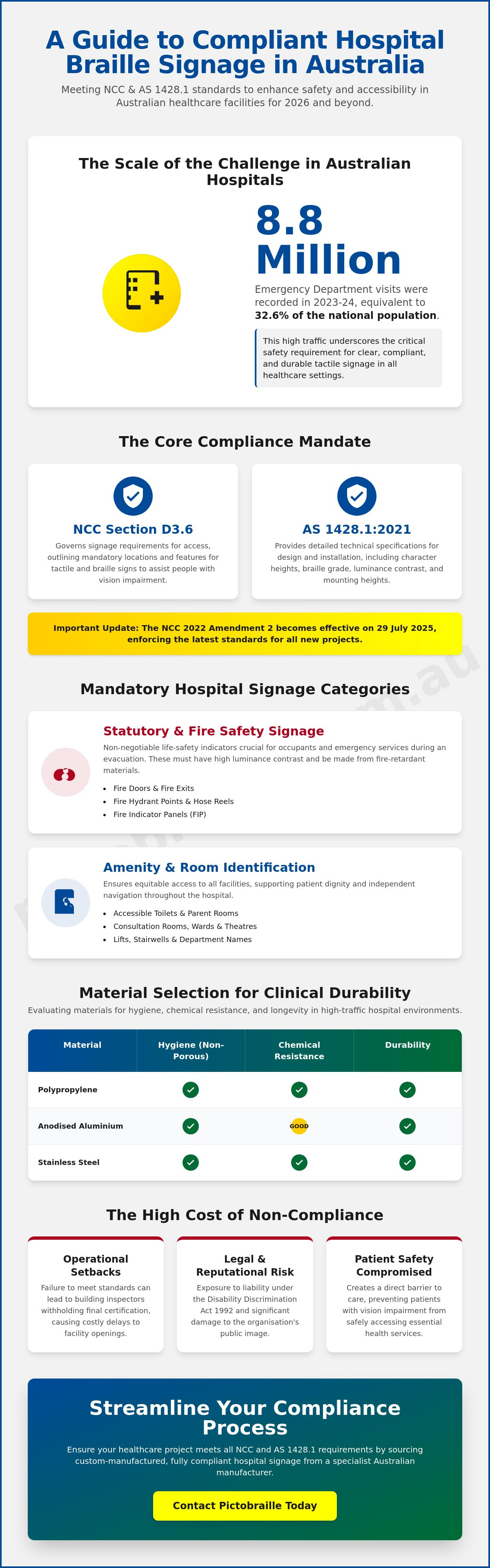
In 2023-24, Australian hospital emergency departments recorded 8.8 million visits, representing 32.6% of the national population. This high volume of traffic makes compliant hospital braille signage a critical safety requirement rather than a secondary design choice. You face the constant challenge of meeting the precise specifications of NCC Section D3.6 and AS 1428.1:2021. Sourcing materials that withstand hospital-grade cleaning while maintaining strict tactile standards is often a point of friction for facility managers and builders.
This guide provides the technical clarity you need to ensure healthcare compliance for 2026. You'll discover the mandatory categories for tactile signage and the material standards required for clinical durability. We'll outline the specific steps to achieve full compliance with the NCC 2022 Amendment 2, which became effective on 29 July 2025. By the end, you'll have a clear list of required signage types and the confidence to source them directly from a specialist Australian manufacturer.
Key Takeaways
- Understand the specific technical requirements of NCC Section D3.6 and AS 1428.1:2021 to ensure full legal adherence for 2026 healthcare projects.
- Identify mandatory hospital braille signage categories, including statutory fire safety indicators and essential amenity room identification for accessible facilities.
- Evaluate material performance across polypropylene, anodised aluminium, and stainless steel to meet strict hospital hygiene and chemical resistance protocols.
- Streamline procurement and project timelines by sourcing custom-manufactured, compliant signs directly from a specialist Australian manufacturer.
- Enhance patient safety and wayfinding efficiency by integrating tactile elements into a broader, compliant facility navigation strategy.
The Role of Hospital Braille Signage in Healthcare Accessibility
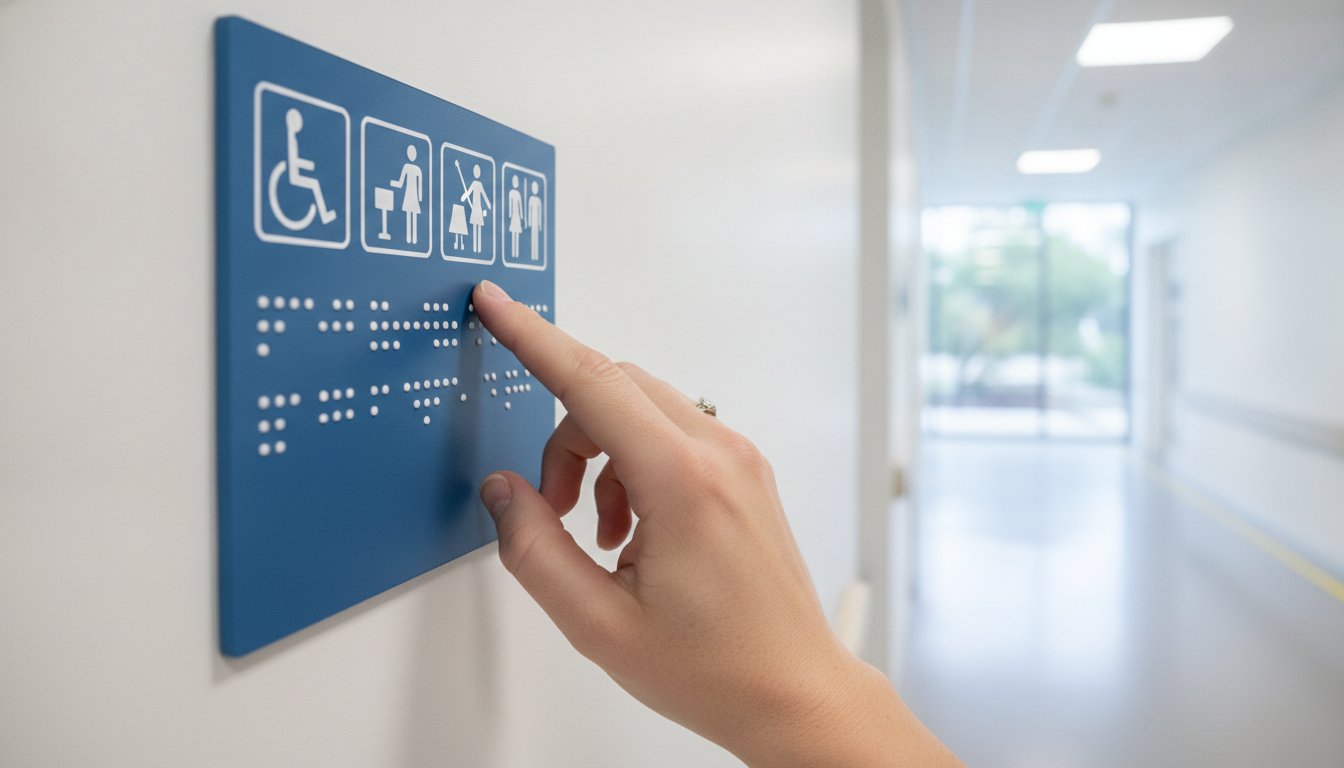
Hospital braille signage serves as a mandatory navigation tool for the 453,000 Australians who are blind or have low vision. In a clinical setting, wayfinding is a critical safety function rather than a decorative choice. Patients and visitors often enter healthcare facilities under significant stress or in urgent need of care. Clear tactile indicators ensure these individuals can locate emergency departments, specialist wards, and essential amenities without relying on external assistance. This independence is fundamental to patient dignity and facility efficiency.
Compliance is a strict legal mandate under the Disability Discrimination Act 1992. This legislation requires Australian public authorities and private healthcare providers to offer equitable access to all services. While international frameworks like the ADA Signage Guidelines provide a global foundation for accessibility principles, Australian facilities must adhere specifically to the National Construction Code (NCC). Failure to install compliant hospital braille signage creates physical barriers to care. It also exposes the healthcare provider to professional liability and the risk of discrimination claims.
Effective wayfinding systems directly improve facility flow and reduce patient anxiety. When users can navigate a complex layout independently, it decreases the frequent interruptions faced by front-line medical and administrative staff. Efficient movement through a hospital depends on these tactile cues. They prevent corridor congestion and ensure that time-sensitive medical appointments or emergency visits are not delayed by poor orientation. A well-planned signage strategy supports a calm, organised, and professional environment.
Why Hospitals Require Specialised Tactile Solutions
Healthcare environments present unique challenges for material durability. Signage must withstand 24/7 high-traffic contact without degrading or delaminating. Unlike standard commercial offices, hospitals use complex alphanumeric room numbering and technical clinical terminology that must be translated accurately into braille. Tactile signs must remain legible under diverse lighting conditions, including dimmed overnight ward corridors and high-intensity surgical bays. Furthermore, materials must be non-porous and resistant to aggressive, hospital-grade chemical disinfectants used in infection control protocols.
The Consequences of Non-Compliant Healthcare Signage
Non-compliance leads to immediate and costly operational setbacks. Building inspectors will withhold final certification or delay facility openings if signage fails to meet NCC Section D3.6 or AS 1428.1:2021 standards. Beyond the initial construction phase, the long-term risks include legal action and damage to the facility's reputation. Most importantly, inadequate signage creates an exclusionary environment. It prevents patients with sensory disabilities from accessing essential health services safely, which contradicts the core mission of any healthcare organisation.
Essential Categories of Tactile Signage for Australian Hospitals
Hospital environments require a structured hierarchy of tactile indicators to manage complex patient flows and safety protocols. Effective hospital braille signage is not a singular product but a system of categorized tools designed for specific regulatory and operational functions. These range from life-safety statutory markers to clinical room identification, each requiring precise adherence to Australian standards. Facility managers must categorize these requirements during the planning phase to ensure no mandatory zone is overlooked.
Statutory and Fire Safety Signage
Statutory signage is a non-negotiable safety requirement. Every fire door, fire hydrant point, and fire indicator panel must be identified with tactile and braille text. These markers are essential for emergency responders and vision-impaired occupants during evacuations. Under the National Construction Code (NCC), these signs must provide high luminance contrast to ensure visibility in smoke-filled or low-light conditions. In narrow hospital corridors where space is limited, Slim Exit Signs offer a compliant solution that maintains clear sight lines without obstructing the path of travel. All fire signage must be manufactured from durable, fire-retardant materials that meet the strict NCC specifications.
Amenity and Restroom Identification
Amenity signage ensures that essential facilities are accessible to everyone. This includes clear identification for accessible toilets, ambulant cubicles, and gender-neutral restrooms. Each sign must use standardized international symbols for accessibility, accompanied by accurate braille descriptors. In large healthcare facilities, consistency is vital. Placing amenity signs at a uniform height and location across multiple levels allows vision-impaired users to develop a mental map of the building. This category also extends to parent rooms and baby change facilities, where tactile text must be used to describe the specific services available within the room. You can browse compliant amenity signs to ensure your facility meets these specific standards.
Custom Clinical and Ward Signage
Clinical room identification is where generic signage often fails. Hospitals require highly specific labels for diagnostic suites, theaters, and consultation rooms. While standard "Male" or "Female" signs are common, a hospital needs custom hospital braille signage for departments like "Pathology," "Radiology," or "Oncology." These signs must integrate room numbers with tactile text to facilitate precise wayfinding. Customisation allows for the inclusion of specific department names that reflect the unique layout of a hospital wing. Pictobraille provides the capacity for bespoke clinical labels, ensuring that even the most specialised medical departments remain fully accessible and easy to navigate for all patients and staff members.
Material Selection: Polypropylene, Aluminium, or Stainless Steel?
Selecting the correct substrate for hospital braille signage is a technical decision based on hygiene protocols and lifecycle costs. Material selection must align with National Construction Code (NCC) requirements for luminance contrast and tactile durability. In clinical environments, the primary concern is the "wipe-down" factor. Signs are subjected to frequent cleaning with hospital-grade disinfectants like sodium hypochlorite or isopropyl alcohol. Choosing a material that resists corrosion and delamination is essential to prevent the accumulation of pathogens in cracked or peeling surfaces.
Clinical lighting is often intense and direct. Non-reflective surfaces are mandatory to prevent glare, which can obscure tactile characters for users with residual vision. Every material specified for healthcare must maintain a matte or satin finish. This ensures legibility remains constant regardless of the light source. Long-term maintenance is also a factor. Durable materials reduce the need for frequent replacements, lowering the total cost of ownership for the facility manager.
Blue and Charcoal Polypropylene: The Industry Standard
Blue Polypropylene Signs are the most recognised option for accessibility due to their high visibility and contrast. This material is the default choice for many Australian healthcare projects because it is lightweight and chemically resistant. For modern hospital interiors, Charcoal Polypropylene Signs or Silver Polypropylene Signs provide a contemporary aesthetic without compromising on technical performance. These materials do not shatter upon impact and are highly cost-effective for large-scale developments. Wholesale sourcing of these signs allows builders to maintain budget discipline while ensuring every room in a multi-storey facility is fully compliant.
Anodised Aluminium and Stainless Steel for Premium Zones
Anodised Aluminium Signs are specified when a sleek, professional finish is required for executive suites or main reception areas. This material offers superior scratch resistance and integrates seamlessly with high-end architectural hardware. For maximum durability, Stainless Steel Signs represent the premium choice. Stainless steel is inherently non-porous and provides the highest level of impact resistance in busy hospital corridors where trolleys and beds are frequently moved. These metal finishes are easy to sanitise and will not degrade over decades of service. Matching these signs with other stainless steel fixtures creates a unified, professional appearance throughout the facility.
Compliance Standards: Meeting NCC and AS 1428.1 Requirements
Compliance with hospital braille signage is a binary requirement. The National Construction Code (NCC) Section D3.6 mandates specific tactile and braille indicators for all new building work in Australian healthcare facilities. These regulations ensure that navigation remains accessible to everyone, regardless of sensory ability. Adherence to AS 1428.1:2021 provides the technical framework for character spacing, height, and tactile protrusion. Manufacturing quality must be consistent. A single error in braille cell placement or tactile height can result in a failed building inspection and delayed facility handovers.
Australia uses Unified English Braille (UEB) Grade 1 for all tactile signage. This standard requires that braille is uncontracted, meaning every letter of a word is represented by a specific braille cell. This ensures maximum clarity and reduces the risk of misinterpretation in high-stress medical environments. You must verify that your signage provider uses precise CNC machining or high-pressure bonding to ensure tactile elements do not peel or shift over time. Durable, high-quality production is the only way to maintain compliance throughout the lifecycle of a hospital wing.
Understanding LRV Contrast for Hospital Signage
Luminance Contrast Value (LRV) is a critical component of visual accessibility. The NCC requires a minimum of 30% luminance contrast between the sign and the wall surface, or between the tactile characters and the sign background. Choosing high-contrast combinations, such as white text on a blue background, is a standard strategy for meeting these requirements. However, you must also consider the LRV of the hospital wall finish. A silver sign on a light grey wall will likely fail a compliance audit because the contrast is insufficient. For builders to ensure final sign-off, LRV contrast is the measurement of light reflected by the sign surface compared to the light reflected by the mounting wall.
Mounting Heights and Installation Rules
Installation errors are the most common cause of compliance failure in Australian hospitals. AS 1428.1:2021 specifies that the baseline of the lowest line of braille must be no less than 1200mm from the floor. Conversely, the highest line of tactile text must be no more than 1600mm from the floor. This range ensures that the sign is reachable for both standing and seated users. Signs must be positioned on the latch side of the door. If the door is a double-swing type or has no latch, the sign should be on the left-hand side. The leading edge of the sign should be between 50mm and 300mm from the door frame. To avoid these errors, you can order NCC-compliant signage that meets every technical specification for Australian healthcare projects.
Sourcing Custom Hospital Signage from an Australian Manufacturer
Sourcing hospital braille signage directly from an Australian manufacturer provides technical certainty for builders, architects, and facility managers. Large-scale healthcare projects involve thousands of individual units across multiple wards and clinical departments. Managing this volume requires a partner with in-house fabrication capabilities and deep regulatory knowledge. Buying direct eliminates the communication gaps often found with generalist printers or international middlemen. This model ensures that every sign produced meets the exact technical specifications required for final building certification.
Consistency is a fundamental requirement for effective wayfinding across a sprawling hospital campus. In 2023-24, Australian emergency departments recorded 8.8 million visits, highlighting the immense pressure on hospital infrastructure. When wayfinding is uniform, patients and staff can navigate high-stress environments with greater efficiency. Centralising production with a specialist manufacturer like Pictobraille guarantees that tactile heights, character spacing, and colour contrast remain identical across every wing of the facility. This uniformity supports the mental mapping required by vision-impaired users for independent navigation.
Custom Fabrication for Unique Healthcare Needs
Healthcare facilities require highly specific nomenclature that generic signage cannot accommodate. Builders can provide detailed signage schedules that include custom room names and specific alphanumeric numbering systems. Pictobraille utilises precision CNC machining to fabricate bespoke labels for specialised departments such as "Haematology," "Neonatal Intensive Care," or "Oncology." This custom process ensures that even the most complex clinical terms are translated into compliant Grade 1 Braille. Design unity is maintained through standardised templates, ensuring that custom text lengths still fit within the regulatory mounting zones specified in AS 1428.1:2021.
Wholesale Solutions for Major Hospital Developments
Major construction firms and national developers require wholesale solutions to manage project budgets and delivery timelines. Bulk ordering allows for significant cost efficiencies on large-volume hospital developments without compromising on material quality. Reliable lead times are a critical component of project management. Local Australian manufacturing ensures that signage is delivered in alignment with phased construction milestones. This proximity eliminates the risks of non-compliant imports or shipping delays that can stall a facility opening. You can Contact Pictobraille for a technical quote on your next hospital project. Our commitment to Australian-made quality and fast turnaround ensures your facility remains compliant, accessible, and ready for service.
Future-Proofing Healthcare Facility Compliance
Adhering to the National Construction Code requires a technical and precise approach to hospital braille signage. You must prioritise materials like high-grade polypropylene or stainless steel to withstand the rigorous hygiene protocols of modern clinical environments. By selecting signs that meet the specific LRV contrast and mounting requirements of AS 1428.1:2021, you eliminate the risk of building certification delays and accessibility barriers. Compliance is the foundation of safe and independent patient navigation.
As a direct Australian manufacturer, we specialise in the technical accuracy required for complex healthcare developments. Our production process ensures that every tactile character and braille cell is positioned to meet exact regulatory specifications. We offer durable polypropylene and premium metal options to suit every ward and clinical suite in your facility. View our range of NCC-compliant hospital braille signage to secure a dependable solution for your next project. Trust in precision manufacturing to deliver the reliability your facility deserves.
Frequently Asked Questions
What are the mandatory braille signage requirements for Australian hospitals?
Mandatory requirements are dictated by NCC Section D3.6 and AS 1428.1:2021. Hospitals must identify all fire exits, accessible amenities, and clinical rooms with tactile and Grade 1 Braille indicators. Signs must be non-reflective and provide high luminance contrast to ensure accessibility for all vision-impaired users. These standards are legally enforceable under the Disability Discrimination Act 1992.
How much luminance contrast is required for hospital braille signs?
A minimum of 30% luminance contrast (LRV) is required between the tactile characters and the sign background, or between the sign and the mounting wall. This ensures the sign remains legible for users with residual vision. Selecting high-contrast combinations, such as white text on blue or charcoal backgrounds, is the industry standard for meeting this technical specification in clinical environments.
Where should tactile signs be mounted in a clinical environment?
Signs must be installed on the latch side of the door at a height between 1200mm and 1600mm from the finished floor level. The baseline of the lowest line of braille must be at least 1200mm high, while the top line of tactile text cannot exceed 1600mm. The leading edge of the sign should be positioned between 50mm and 300mm from the door frame to ensure accessibility.
Can hospital braille signs be custom-made with specific ward names?
Yes, hospital braille signage can be custom-manufactured to include specific department names, ward identifiers, and clinical room numbers. Customisation ensures that specialised units like "Radiology" or "Intensive Care" are clearly labelled using compliant Grade 1 Braille. We utilise precision technology to translate unique clinical terminology into standardised tactile formats that meet all Australian building codes.
What is the best material for hospital signs that require frequent cleaning?
Stainless steel and anodised aluminium are the superior choices for environments requiring aggressive chemical disinfection. These non-porous metals resist corrosion and impact in high-traffic corridors. For a more cost-effective solution, high-grade polypropylene also offers excellent chemical resistance and durability against hospital-grade cleaning agents without delaminating or shattering over time.
Are slim tactile exit signs compliant for use in hospital corridors?
Slim tactile exit signs are fully compliant provided they meet the character height and tactile protrusion standards of AS 1428.1. These signs are specifically designed for narrow hospital hallways or areas with restricted wall space. They provide the necessary statutory fire safety identification while maintaining clear sightlines and minimising physical obstruction in busy medical wings.
Does Pictobraille manufacture signs that meet AS 1428.1 and NCC standards?
Every sign we manufacture is designed to exceed the requirements of NCC Section D3.6 and AS 1428.1:2021. As a specialist Australian manufacturer, we maintain strict quality control over tactile heights and braille cell dimensions. This technical precision ensures that our products pass building inspections and provide reliable navigation for vision-impaired individuals in healthcare settings across Australia.
How do I calculate the required number of braille signs for a new hospital wing?
Calculation begins with a thorough audit of the architectural floor plans to identify every fire exit, accessible restroom, and clinical room. You must cross-reference these plans with NCC Section D3.6 mandates for statutory and amenity signage. Providing a detailed schedule of room names to your manufacturer ensures that no mandatory tactile indicator is missed during the procurement and installation phases.