
Accessible Signage Checklist for Australian Builders: NCC Section D3.6 Compliance
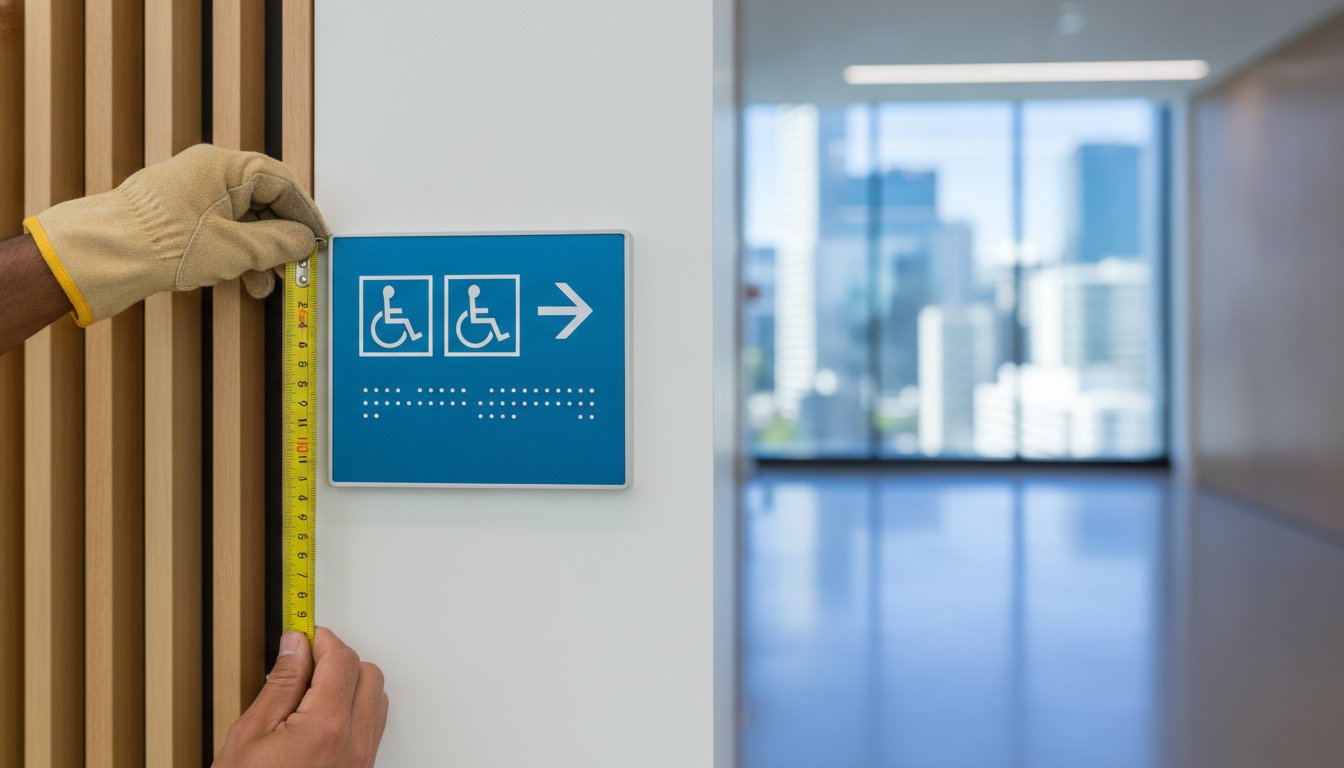
Compliance is a binary state. Your project either passes final inspection or it fails. Sourcing compliant accessible signage for builders often becomes a high-stakes bottleneck during the final stages of a commercial build. You understand the pressure of meeting handover deadlines while deciphering the technical nuances of NCC 2022 Section D4D7. It's a common frustration to face certification delays because of minor mounting errors or non-compliant Braille spacing.
This guide provides a strict, fact-first framework to ensure your braille and tactile signage meets all Australian regulatory standards. We will outline the exact signs required by AS 1428.1-2021, clarify 30% luminance contrast requirements, and specify the mounting heights necessary for immediate certification. We focus on the physical attributes and durability of materials like anodised aluminium and polypropylene. You will gain a clear list of required signs and the technical measurements needed to avoid costly retrofitting or discrimination complaints under the Disability Discrimination Act.
Key Takeaways
- Identify mandatory signage categories under NCC 2022 and AS 1428.1-2021 to guarantee your project passes final certification.
- Understand critical technical specifications, including the 30% luminance contrast requirement between tactile characters and sign backgrounds.
- Evaluate high-performance materials such as anodised aluminium and polypropylene when selecting accessible signage for builders to ensure durability.
- Apply precise installation standards for mounting heights and door positioning to meet strict Australian accessibility guidelines.
- Optimise procurement by sourcing directly from local manufacturers to reduce lead times and ensure signs arrive ready for immediate installation.
Understanding NCC Section D3.6 and AS 1428.1 Requirements
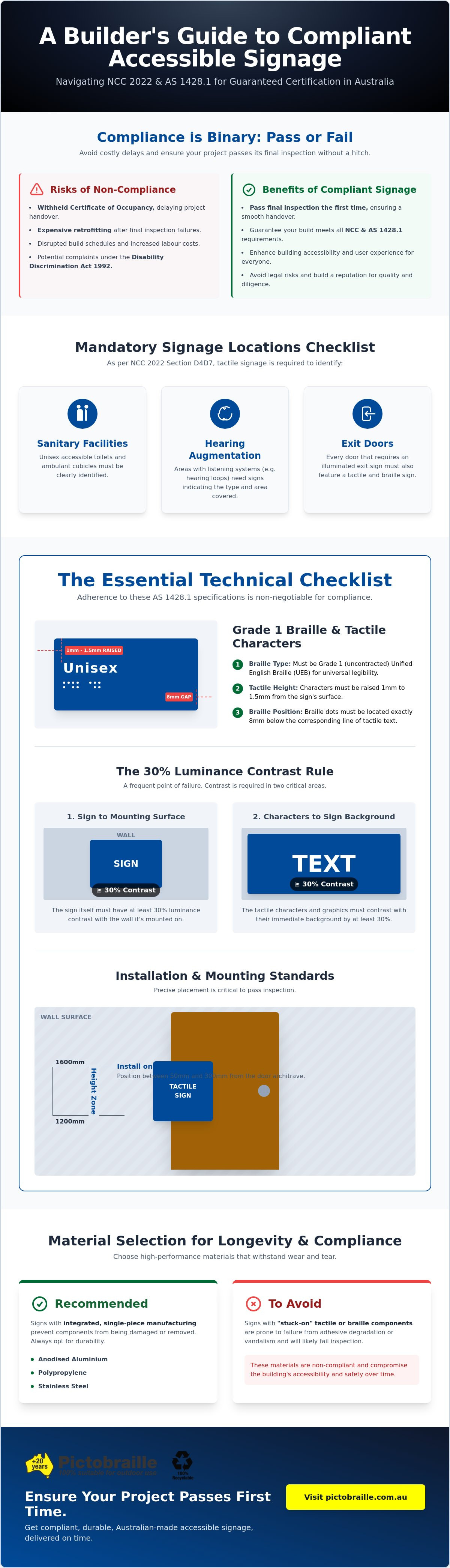
Compliance is the primary objective for any commercial fit-out. The National Construction Code (NCC) 2022, specifically Section D4D7, mandates the installation of braille and tactile signage across various building classes. These regulations ensure that individuals with vision impairment can navigate the built environment with autonomy. Every piece of accessible signage for builders must adhere to the technical specifications outlined in Australian Standard AS 1428.1. Failing to meet these benchmarks often results in a withheld Certificate of Occupancy. Retrofitting non-compliant signs after the final inspection is expensive and disrupts handover schedules. Builders should identify all required signs during the early procurement phase to avoid these delays.
The Australian regulatory landscape is unforgiving regarding accessibility. If a sign doesn't meet the exact luminance contrast or tactile height requirements, it's non-compliant. This isn't a matter of aesthetic preference; it's a legal obligation under the Disability Discrimination Act 1992. You need a safe pair of hands to provide signs that pass inspection the first time. Procurement should focus on technical accuracy rather than just the lowest unit price.
Mandatory Signage Categories for Commercial Buildings
Regulatory requirements focus on essential facilities and safety routes. All sanitary facilities must be identified with compliant signs. This includes unisex accessible toilets and ambulant cubicles. If a building features hearing augmentation systems, specific tactile indicators must identify the type of system and the area covered. Additionally, every door required to have an illuminated exit sign must also feature a corresponding tactile and braille component. Precise identification isn't optional. It's a fundamental requirement for the final building sign-off.
The Role of Grade 1 Braille in Australian Compliance
Technical accuracy defines a compliant sign. All braille used in Australian commercial projects must be Grade 1 (uncontracted) Unified English Braille (UEB). This ensures the text is legible to the widest possible user base. The physical construction of the sign is equally critical. Tactile characters must have a raised profile of 1mm to 1.5mm from the base surface. Braille dots must be positioned exactly 8mm below the bottom line of the corresponding tactile text. These measurements are strict. Even a minor deviation can lead to an inspection failure. Choosing high-quality accessible signage for builders that's manufactured to these exact tolerances is the only way to guarantee approval.
The Essential Technical Checklist for Compliant Tactile Signage
Compliance depends on precise physical attributes. Builders must verify more than just the presence of a sign. You must audit the Luminous Reflective Value (LRV) and the physical integrity of the tactile elements during the fit-out. High-quality accessible signage for builders uses integrated manufacturing processes. In these processes, braille and characters are part of the sign body itself. This prevents components from being removed or damaged. Avoid signs with "stuck on" components. These often fail over time due to adhesive degradation or vandalism.
Visual indicators are mandatory for specific facilities and safety routes. Ensure the international symbol of access is clearly visible on all accessible toilet signs. Similarly, spaces equipped with hearing loops require the international symbol for deafness. Fire safety signage also falls under strict NCC durability requirements. These signs must withstand high-traffic environments without losing legibility or tactile definition. Using materials like stainless steel or anodised aluminium ensures these safety markers remain functional for the life of the building.
LRV Contrast: The 30% Rule
Contrast is a frequent point of failure during building inspections. Signs must achieve a minimum 30% luminance contrast with the mounting surface. Additionally, the tactile characters must contrast with the sign background by at least 30%. LRV is the total quantity of light reflected by a surface in all directions when illuminated by a light source. This measurement determines how easily a person with low vision can distinguish a sign from its environment. Selecting compliant tactile signs with pre-calculated LRV values simplifies this verification process and removes the guesswork from your compliance checklist.
Tactile Graphic and Character Specifications
Character design is strictly regulated by AS 1428.1 to ensure universal accessibility. All text must be sans serif to avoid tactile confusion. Character height must remain between 15mm and 55mm. Symbols and pictograms require a dedicated field of at least 110mm x 110mm. This spacing prevents crowding and allows users to identify the symbol through touch without interference from surrounding text.
Safety is a critical consideration for tactile elements that users must touch. Ensure no sharp edges exist on the raised characters or symbols. Smooth, rounded finishes prevent user injury during tactile reading. Using injection-moulded polypropylene or precision CNC-machined aluminium ensures these safety standards are met consistently across every sign in your project. These materials provide the necessary durability for high-traffic commercial environments while maintaining strict compliance with Australian standards.
Selecting Materials for Longevity and Inspection Approval
Material performance directly impacts long-term compliance. In the Australian climate, UV stability and resistance to harsh cleaning agents are essential requirements. High-quality accessible signage for builders must withstand frequent physical contact without the tactile elements wearing down or detaching. Polypropylene remains the preferred industry standard because it's lightweight, cost-effective, and exceptionally durable. This material is typically injection-moulded. This process ensures the tactile components are an integral part of the sign body rather than separate attachments that can be vandalised or lost over time.
Premium projects require a more sophisticated finish. Anodised Aluminium Signs provide a high-end aesthetic suitable for commercial foyers and corporate environments. This material combines structural rigidity with a high-performance surface that resists fingerprints and scratches. For industrial sites or coastal locations with high salt exposure, Stainless Steel Signs are the primary choice. These materials ensure that the sign remains legible and firmly attached in aggressive environments. Material choice is a critical factor in passing subsequent safety audits years after the initial building handover.
Polypropylene Options: Blue, Silver, Charcoal, and Black
Colour choice is primarily dictated by the mounting surface's Luminous Reflective Value (LRV) to ensure compliance. Blue Polypropylene Signs are the traditional selection for standard accessible toilet facilities across Australia. For modern architectural palettes, Silver Polypropylene Signs and Charcoal Polypropylene Signs allow builders to maintain design consistency without sacrificing regulatory standards. Black Polypropylene Signs offer the highest contrast on light-coloured or white-washed walls. This ensures the mandatory 30% luminance contrast requirement is met without compromise, even in high-glare environments. Using these varied options allows for a functional fit-out that respects the building's interior design.
Specialised Solutions: Slim Tactile Exit Signs
Architectural constraints often limit available wall space near doorways. Slim Exit Signs are specifically engineered for installation on narrow architraves or limited wall segments near fire doors. These signs solve the problem of restricted space while maintaining the mandatory character heights and braille spacing required by AS 1428.1. They're an ideal solution for modern designs where minimal wall footprints are required. Using these specialised accessible signage for builders ensures that even the most compact exit routes remain fully compliant with safety and accessibility laws. They provide a streamlined appearance without the need for bulky mounting plates.
Installation Standards: Mounting Heights and Door Positioning
Precision during installation is as critical as the sign's manufacturing. A compliant sign becomes non-compliant if it's mounted at the wrong height or in the wrong location. AS 1428.1-2021 dictates exact positioning to ensure that individuals with vision impairment can locate and read the tactile information safely. Consistent placement allows users to predict where a sign will be located across different buildings. For most commercial projects, accessible signage for builders must be installed on the wall on the latch side of the door. This ensures the sign is always found near the door handle where a user's hand naturally gravitates.
Vertical positioning must adhere to strict millimetre measurements. The baseline of the lowest tactile character or symbol must be at least 1200mm above the finished floor level. Conversely, the top of the highest tactile character or symbol must not exceed 1600mm above the floor. This range accommodates the majority of users, including those in wheelchairs or with varying heights. Additionally, signs must be mounted with a minimum 50mm clearance from the edge of the door frame or architrave. This prevents the sign from being obscured by the door's hardware or the user's own body when they're operating the handle.
Determining the Latch Side for Double Doors
Double doors require a specific approach to maintain navigational consistency. For these configurations, the sign should be placed on the right-hand side unless the architectural layout dictates a specific active leaf. You must ensure the sign isn't obscured when a door is held in the open position by magnetic holds or floor stops. Tactile indicators must remain reachable without the user entering the door's swing path. This safety requirement prevents the user from being struck by a door that's opened from the opposite side while they're reading the braille. To ensure your project meets these exact specs, you can order compliant braille signs that arrive ready for immediate, correct placement.
Surface Preparation and Adhesive Requirements
Bonding integrity is essential for long-term compliance and safety. Mounting surfaces must be clean, dry, and free of dust or oils before you attempt installation. Contaminants on the wall will compromise the adhesive and lead to sign failure. Most Blue Polypropylene Signs or Charcoal Polypropylene Signs come with high-bond adhesive backing for rapid installation on smooth surfaces. However, for textured walls or outdoor environments, mechanical fixings are often necessary. Stainless Steel Signs and Anodised Aluminium Signs typically require these permanent fixings to withstand UV exposure and temperature fluctuations. Secure mounting prevents the sign from being easily removed or shifting over time, which would invalidate the initial building certification.
Streamlining Procurement Through Direct Manufacturer Sourcing
Direct procurement is the final step in securing a compliant build. Sourcing accessible signage for builders directly from the manufacturer eliminates the technical risks associated with generalist print shops. You gain immediate access to expertise regarding NCC 2022 Section D4D7. This relationship ensures faster lead times, particularly for custom projects requiring non-standard room naming. In-house manufacturing guarantees that every braille and tactile element is integrated into the sign base. This process prevents the component failure common in low-quality imports. You receive signs that are built for the life of the building.
Efficiency increases when you bulk order standard components for large-scale developments. These projects often require hundreds of individual markers, including Fire Signage and Exit Signs. Ordering these alongside custom room identifiers reduces total project costs and simplifies logistics. You receive a single, organised shipment where every sign is ready for immediate installation. This methodical approach to procurement prevents the last-minute scramble for compliant markers before the final building inspection. It ensures your handover remains on schedule.
Custom Tactile Solutions for Unique Project Needs
Architectural specifications often demand more than standard toilet signs. Custom room numbers and facility names must be manufactured to match specific interior themes while maintaining strict compliance. Builders can specify premium materials like Anodised Aluminium Signs to meet high-end client briefs. Direct communication with the production team reduces errors in braille layout and translation. You ensure that specific identifiers, such as "Level 4 Comms Room" or "Parent's Room", are rendered correctly in Grade 1 UEB. This level of precision is only possible when working with a specialised manufacturer that controls the entire production cycle from design to dispatch.
Why Builders Trust Pictobraille for NCC Compliance
Pictobraille operates as a dedicated specialist in the production of braille and tactile indicators. We focus exclusively on this sector. This specialisation ensures deep technical expertise in every product we ship to Australian worksites. All signs are manufactured in Australia to meet or exceed AS 1428.1-2021 standards. You are partnering with a master manufacturer, not a middleman. This provides the peace of mind required for high-stakes commercial handovers. Our production processes ensure that every sign provides the necessary 30% luminance contrast and precise tactile height for immediate certification.
Organise your compliant signage today with Pictobraille to secure your project's final approval.
Finalising Your Compliance Framework
Compliance is the end result of technical precision. You've reviewed the essential requirements for NCC 2022 and AS 1428.1-2021, from mounting heights to the 30% luminance contrast rule. Implementing these standards correctly prevents the delays and costs associated with failed inspections. High-quality accessible signage for builders ensures that your project meets every regulatory benchmark before the final walk-through. Precise placement on the latch side of the door and verified LRV contrast are the final steps to securing your Certificate of Occupancy.
Choosing the right partner simplifies the path to certification. As a direct Australian manufacturer and a specialist in AS 1428.1 compliance, we provide the technical accuracy your project demands. Our range includes durable polypropylene and metal options designed to withstand high-traffic commercial use. You can trust that our signs arrive ready for immediate, compliant installation. View our range of NCC-compliant tactile signage and secure your project's approval. Your commitment to these technical standards ensures a seamless handover and long-term accessibility for all building users.
Frequently Asked Questions
Is braille signage mandatory for all commercial buildings in Australia?
Mandatory requirements apply to all Class 2 to 9 buildings under the National Construction Code. You must install accessible signage for builders in specific areas, including accessible toilets, ambulant cubicles, and rooms with hearing augmentation systems. Additionally, any door required to have an exit sign must also feature a tactile and braille equivalent to ensure the building meets Australian safety and accessibility standards.
What is the standard mounting height for braille signs in 2026?
Tactile components must be located between 1200mm and 1600mm above the finished floor level or ground surface. For signs with a single line of characters, the tactile baseline should be positioned between 1250mm and 1350mm from the floor. These specific measurements, defined in AS 1428.1-2021, ensure that the information remains within the reach and sightline of all users, including those in wheelchairs.
Can I use custom colours for my tactile signs and still be compliant?
Custom colours are compliant provided they maintain a minimum 30% luminance contrast with both the mounting surface and the tactile characters. Builders often select Charcoal Polypropylene Signs or Silver Polypropylene Signs to align with modern architectural palettes. You must verify the Luminous Reflective Value (LRV) of the sign background against the wall colour to guarantee the 30% contrast threshold is satisfied for the final inspection.
What is the difference between Grade 1 and Grade 2 braille for Australian signs?
Grade 1 braille is uncontracted, letter-for-letter text, while Grade 2 uses contractions as a form of shorthand. Australian Standard AS 1428.1 specifically mandates Grade 1 Unified English Braille (UEB) for all public signage. This standard ensures the information is accessible to the widest range of braille readers, including those who may not be fluent in the more complex Grade 2 contractions used in literature.
What happens if my signage does not meet the 30% LRV contrast requirement?
Failing the 30% LRV contrast requirement will result in a withheld Certificate of Occupancy during the final building inspection. This leads to expensive retrofitting and potential legal liability under the Disability Discrimination Act. It's critical to source accessible signage for builders that provides pre-verified contrast values. This proactive approach avoids costly handover delays and ensures the building is inclusive for individuals with vision impairment.
Are slim tactile exit signs compliant with NCC Section D3.6?
Slim Exit Signs are fully compliant provided they adhere to the mandatory character heights of 15mm to 55mm and the required braille spacing. These signs are specifically engineered for narrow architraves or limited wall segments near fire doors. They provide a streamlined solution for modern architectural designs where wall space is at a premium, ensuring that even compact exit routes meet all safety and accessibility laws.
Do fire hydrant and fire indicator panel signs need to be tactile?
Fire safety signage identifying exits or paths of travel must include tactile and braille components under the NCC. While specific fire equipment markers follow AS 2444, identifying the location of essential fire safety facilities often requires tactile elements to assist vision-impaired occupants during an emergency. Using integrated Fire Signage ensures these safety markers meet the necessary durability standards for high-traffic commercial environments.
How do I install braille signs on glass partitions?
Signs on glass partitions should be installed using high-bond double-sided adhesive. To maintain a professional aesthetic, apply a blank backing plate on the opposite side of the glass to conceal the adhesive tape. This method ensures the sign remains securely fixed while hiding the reverse side of the installation. It's a common requirement in modern office fit-outs to maintain visual consistency across transparent partitions.