
Ambulant Toilet Braille Sign: NCC Compliance and AS1428.1 Standards
A single non-compliant sign can stall a multi-million dollar building handover. For trade professionals and builders, the ambulant toilet braille sign is often a late-stage detail that carries significant regulatory weight. You understand that failing a final inspection due to incorrect tactile height or poor contrast ratios is a risk your project timeline can't afford. Confusion between ambulant and fully accessible requirements frequently leads to installation errors that require expensive on-site fixes.
This technical guide ensures your project meets the latest Australian accessibility standards, including NCC 2025 and AS 1428.1-2021. You'll gain clarity on the exact specifications required for compliant signage, from Grade 1 Braille spacing to the critical 30% luminance contrast rule. We'll examine the differences between male, female, and unisex ambulant requirements, alongside precise mounting instructions to guarantee your signage passes inspection the first time.
Key Takeaways
- Identify the critical design distinctions between ambulant and fully accessible facility requirements to prevent regulatory non-compliance during building handovers.
- Master the technical specifications of NCC Section D3.6 and AS 1428.1, focusing on the mandatory 15mm tactile character height and Grade 1 Braille.
- Ensure every ambulant toilet braille sign meets the mandatory 30% Luminance Contrast (LRV) requirement relative to the mounting surface to assist vision-impaired users.
- Achieve first-time inspection success by following precise installation rules for mounting heights between 1200mm and 1600mm on the door’s latch side.
- Optimise project timelines and procurement costs by sourcing direct from an Australian manufacturer specialising in precision-engineered tactile signage.
Understanding Ambulant Toilet Braille Sign Requirements
The National Construction Code (NCC) defines an ambulant toilet as a facility designed for individuals with mobility limitations who don't require a wheelchair. This includes people using walking frames, canes, or those with sensory disabilities. An ambulant toilet braille sign is a mandatory component for these facilities under NCC Volume One. It ensures that vision-impaired users can independently navigate commercial environments. Unlike general directional signage, these markers must include raised tactile characters and Grade 1 Braille to meet Australian standards.
Building triggers for these signs occur in almost all new commercial developments or major refurbishments where sanitary facilities are provided. If a project includes separate male and female toilet blocks, at least one ambulant cubicle is typically required in each. The signage must explicitly state the gender or identify the facility as unisex to prevent confusion and ensure the building remains compliant with the Disability Discrimination Act (DDA).
Ambulant vs Accessible: Signage Distinctions
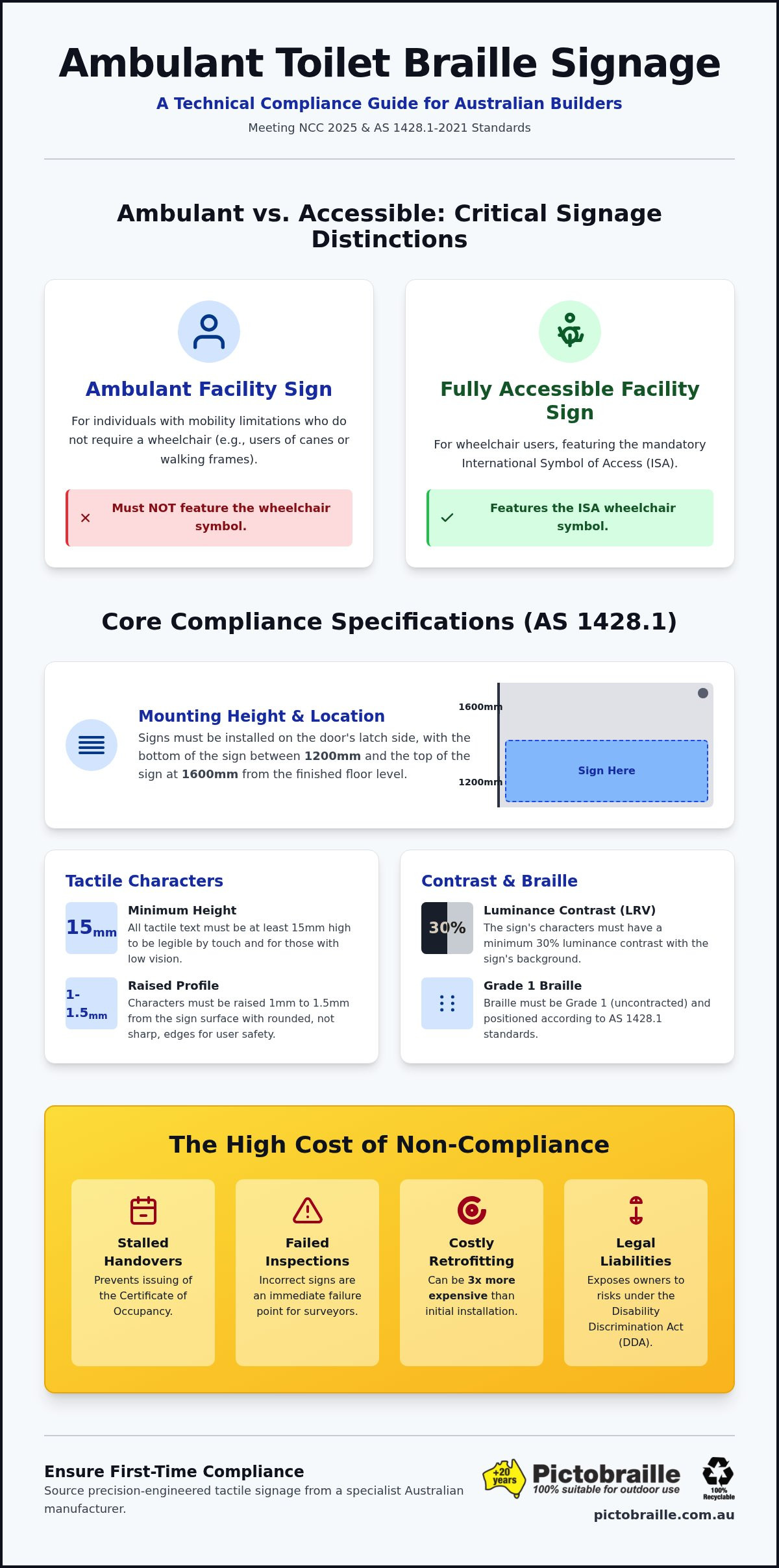
Distinguishing between ambulant and fully accessible signage is a common point of confusion for contractors. Accessible signs feature the International Symbol of Access (ISA), which is the standard wheelchair icon. An ambulant sign must never feature the wheelchair symbol. Instead, it uses specific text and, in some cases, a symbol representing a person with walking aids. Tactile communication principles often align with international ADA Signage Guidelines, but Australian law dictates specific geometry and placement for local projects.
Mandatory text is a core requirement. Every sign must clearly identify the cubicle as "Ambulant" and include the appropriate gender prefix. For example, a "Male Ambulant" or "Female Ambulant" sign is required when the facility is located within a gender-specific block. If the facility is an all-gender or unisex space, the signage must reflect this accurately to meet NCC 2025 standards.
The Consequences of Non-Compliant Signage
Installing an incorrect ambulant toilet braille sign is more than a minor oversight; it's a significant regulatory risk. Building surveyors will fail a final inspection if signage lacks the correct tactile height or contrast ratios. This prevents the issuance of a Certificate of Occupancy, which can delay project handovers and trigger liquidated damages. Retrofitting compliant signs after a building is occupied is often three times more expensive than getting it right the first time. Beyond the immediate costs, non-compliant signage exposes building owners to legal liabilities under the DDA if a facility is deemed inaccessible due to poor navigation markers.
Technical Specifications: NCC Section D3.6 and AS1428.1
The National Construction Code (NCC) provides the legal mandate for accessibility, while AS 1428.1-2021 serves as the technical blueprint. Section D3.6 of the NCC specifically outlines the requirements for braille and tactile signage in commercial buildings. Every ambulant toilet braille sign must conform to these standards to ensure the building is fit for occupancy. Compliance isn't a suggestion; it's a strict regulatory requirement that building surveyors scrutinise during final inspections. Precise adherence to these measurements is the only way to guarantee a project passes its final audit without costly delays.
Character height is a fundamental metric that often determines compliance. AS 1428.1-2021 mandates that tactile characters must have a minimum height of 15mm. This ensures the text is large enough to be read by touch and remains visible to those with low vision. Using undersized text is one of the most common reasons for signage rejection in Australian commercial projects. High-quality manufacturing processes ensure that every character meets this 15mm threshold with absolute consistency across a complete signage package.
Tactile Element Precision
Precision in the third dimension is vital for functional accessibility. Tactile characters must be raised between 1mm and 1.5mm from the sign's background surface. This specific elevation range provides enough definition for tactile reading while maintaining the sign's structural integrity. AS 1428.1 requires these characters to have rounded edges rather than sharp, vertical profiles. Sharp or abrasive surfaces are non-compliant because they can cause skin irritation or injury to the user. A smooth, rounded profile is essential for a safe and functional user experience.
Braille Positioning and Standards
Braille dots must follow a highly regulated layout to be useful for vision-impaired individuals. The standard requires the braille to be positioned 8mm below the bottom line of the tactile text. In Australia, Grade 1 Braille is the mandatory format for these signs. This uncontracted version of braille is the most accessible for the majority of users. AS 1428.1 also mandates that braille must be left-justified, regardless of whether the tactile text above it is centred or left-aligned. This standardisation allows users to locate the start of the braille message predictably every time.
Hygiene and longevity are often overlooked during the procurement phase. Embossed signs offer a significant advantage over those with glued-on characters. A one-piece construction method ensures that tactile elements cannot be picked off or fall off over time. It also eliminates gaps where dirt and pathogens can accumulate, making the signs much easier to clean in high-traffic environments. For builders looking to avoid future maintenance issues, sourcing embossed tactile signage provides a durable solution that stays compliant for the life of the building.
Material Selection and LRV Contrast Requirements
Compliance for an ambulant toilet braille sign relies on the science of light reflectance. The 30% Luminance Contrast Value (LRV) rule is a non-negotiable requirement under AS 1428.1. It ensures that the sign remains legible for users with low vision. This contrast must be achieved in two distinct areas: between the tactile characters and the sign background; and between the sign background and the mounting wall. Simply choosing a "high contrast" colour is insufficient; the specific reflectance values must meet the 30% threshold to pass a building audit.
Blue polypropylene is the industry standard for most Australian commercial projects. It provides a reliable LRV that contrasts effectively with common light-coloured wall finishes like off-white or light grey. However, modern architectural palettes often require alternative finishes. Charcoal, black, and silver polypropylene signs offer a more integrated aesthetic for contemporary interiors. When using these darker or metallic backgrounds, the tactile elements must be carefully selected to maintain the mandatory contrast levels. For instance, a black sign background requires white or light-coloured characters to remain compliant.
Polypropylene: The Trade Favourite
Polypropylene is the preferred material for high-traffic public facilities due to its chemical resistance. Public toilets require frequent, heavy-duty cleaning with aggressive sanitising agents; polypropylene does not degrade or discolour under these conditions. In-house manufacturing allows for strict control over colour density, ensuring that every batch meets the required LRV specifications. This material is also the most cost-effective solution for large-scale developments, such as schools or shopping centres, where dozens of signs are required across multiple levels.
Metal Signage for Premium Fit-Outs
Anodised aluminium and stainless steel signs are designed for prestige corporate environments or harsh coastal locations. Anodised aluminium provides a sleek, professional finish that balances aesthetics with strict compliance. Stainless steel offers the highest level of durability and is virtually indestructible in high-vandalism areas. Maintaining the 30% LRV rule on metallic surfaces requires precision. A silver or brushed metal background typically necessitates black tactile characters and braille to ensure the sign is functional for all users. These premium materials provide a long-term solution that withstands both environmental stress and heavy physical use.
Correct Installation and Placement of Ambulant Signs
Precise installation is as critical as the sign's physical properties. AS 1428.1-2021 dictates exact vertical and horizontal positioning to ensure functional accessibility. An incorrectly placed ambulant toilet braille sign is a compliance failure, regardless of its manufacturing quality. Builders must verify mounting heights and distances before fixing to avoid costly wall repairs and inspection delays.
Tactile and braille components must be located between 1200mm and 1600mm above the finished floor level. For signs containing a single line of characters, the tactile text must sit between 1250mm and 1350mm. This consistency allows vision-impaired users to locate information reliably across different facilities. Measuring from the finished floor level, rather than the structural slab, is essential to account for tile or floor finish thickness.
The Latch Side Installation Rule
Signs must be mounted on the wall on the latch side of the door. This positioning ensures the user is not struck by a door opening outward while attempting to read the tactile elements. The leading edge of the sign must be positioned between 50mm and 300mm from the door architrave. If wall space on the latch side is unavailable, the sign may be placed on the non-latch side. Placement on the door itself is a last resort and is only permitted under specific NCC exceptions where no wall space exists on either side.
Mounting Methods for Longevity
Durability depends on the bond between the sign and the substrate. Very High Bond (VHB) tapes provide a permanent, moisture-resistant fixing suitable for most smooth surfaces like tiles or painted plasterboard. For uneven masonry or high-vandalism areas, mechanical fixings or construction-grade adhesives are required. Installing on glass partitions requires a matching backing plate to conceal the adhesive from the reverse side. Every sign must be checked with a spirit level to ensure it is plumb and professional. If you need to secure your project with code-compliant markers, you can order an ambulant toilet braille sign directly from our Australian manufacturing facility.
Surface preparation is the final step in a successful installation. All mounting surfaces must be free of dust, grease, and moisture before applying adhesives. On highly textured walls, a combination of VHB tape for immediate grab and silicone for long-term adhesion is often the most reliable method. Following these steps ensures the signage remains fixed for the life of the building, maintaining compliance and user safety.
Sourcing Direct from an Australian Manufacturer
Sourcing directly from an Australian manufacturer eliminates the risks associated with imported signage that may not meet local standards. Pictobraille manages the entire production cycle in-house. This ensures every ambulant toilet braille sign produced is compliant with NCC and AS 1428.1 before it leaves the factory floor. Dealing directly with the manufacturer provides trade professionals with better pricing, faster lead times, and direct access to technical expertise. You aren't just buying a product; you're securing a compliance guarantee for your project.
Wholesale and bulk ordering options are available for large-scale commercial developments. This is particularly beneficial for multi-storey projects or healthcare facilities where dozens of compliant signs are required. Direct-to-trade pricing ensures project budgets remain on track without compromising on regulatory compliance or material quality. Our facility is equipped to handle high-volume orders with the same precision applied to individual custom pieces.
Quality Control in Tactile Production
Quality control is rigorous in our Australian facility. Unlike resellers who source from multiple third parties, we maintain total oversight of material density, tactile height, and braille accuracy. Every sign undergoes a verification process to ensure it meets AS 1428.1-2021 standards. This "safe pair of hands" approach means you receive high-durability products that won't fail a building inspection. Supporting local manufacturing also simplifies project management, as communication is direct and logistics are streamlined.
Custom Tactile Solutions
Standard signs don't always align with a specific architectural vision. We offer custom manufacturing to match building colour palettes while maintaining the mandatory 30% LRV. Our range includes charcoal, black, and silver polypropylene, as well as premium anodised aluminium and stainless steel. We also produce slim exit signs and fire signage to create a cohesive, compliant look throughout a commercial space. Enquire today for custom manufacturing quotes to receive a solution tailored to your project’s exact specifications.
Technical accuracy is the foundation of our production process. If a custom design risks falling outside the 30% contrast threshold, we'll advise on material or colour adjustments before production begins. This proactive approach prevents the installation of non-compliant signage and ensures your building meets all accessibility requirements from day one. Our expertise in NCC Section D3.6 allows us to guide you through complex requirements with confidence and precision.
Securing Compliance for Your Next Project
Precision in tactile signage is a fundamental requirement for any successful building handover. You now understand that a compliant ambulant toilet braille sign requires more than just the right text; it demands exact character heights, specific Grade 1 Braille spacing, and a minimum 30% luminance contrast. Correct installation on the latch side of the door, at a height between 1200mm and 1600mm, ensures your project meets the rigorous standards of AS 1428.1 and NCC Section D3.6.
Don't risk inspection delays with non-compliant imports. Browse our range of NCC-compliant ambulant toilet signs to secure high-quality, Australian-made solutions. Our signs are Australian-made in our own fabrication facility and are available in durable blue, charcoal, silver, and black polypropylene to suit any architectural finish. By choosing a specialist manufacturer, you ensure technical accuracy and long-term durability for every facility in your development. We look forward to supporting your next build with precision-engineered signage.
Frequently Asked Questions
Is an ambulant toilet sign the same as a disabled toilet sign?
No, these are distinct facility types with different requirements. An ambulant toilet braille sign identifies cubicles for users with mobility aids, such as canes or walkers, who do not require a wheelchair. Accessible or "disabled" signs feature the International Symbol of Access (wheelchair icon) and denote larger spaces designed specifically for wheelchair users. Mixing these symbols is a compliance failure.
Can I install an ambulant braille sign directly on the toilet door?
Door mounting is only permitted if wall space is unavailable on both sides of the door. NCC Section D3.6 requires the sign to be fixed to the wall on the latch side first. If this is impossible, the hinge side is the second option. Door installation is the final alternative allowed by the code to avoid project non-compliance during a final building audit.
What is the required height for ambulant toilet braille signs?
Tactile elements must be positioned between 1200mm and 1600mm above the ground. For signs with a single line of text, the characters must sit between 1250mm and 1350mm from the finished floor level. These precise measurements ensure the sign remains reachable and legible for all users regardless of their height or the type of mobility aid they use.
What colour should my ambulant toilet sign be for NCC compliance?
No specific colour is mandated by the NCC, but the sign must provide a 30% luminance contrast. Blue polypropylene is the industry standard because it contrasts effectively with light-coloured walls. Charcoal, silver, or black signs are also compliant if the background and tactile elements meet the 30% LRV threshold against the mounting surface and each other.
Is unisex ambulant signage required for every bank of toilets?
Signage must reflect the facility's specific designation within the building. If the toilets are gender-segregated, you must use male or female ambulant signs respectively. Unisex signs are required only for standalone all-gender facilities or when specifically required by the building's design classification under the latest NCC updates. Always verify the floor plan before ordering.
What happens if my signage does not have enough LRV contrast?
Insufficient contrast results in a failed building inspection and the withholding of a Certificate of Occupancy. Building surveyors use LRV data to verify that the sign is functional for users with low vision. If the 30% threshold isn't met, you'll be forced to replace the signage at your own cost before the building can be legally occupied.
Do I need a separate sign for male and female ambulant toilets?
Yes, gender-specific blocks require individual identification. A male block containing an ambulant cubicle requires a specific "Male Ambulant" sign. Using a generic or unisex ambulant toilet braille sign in a gendered block is incorrect. This mistake will lead to user confusion and regulatory rejection during the final certification process of your commercial project.
Can I use a custom font for the tactile characters on my sign?
Custom fonts are generally prohibited for tactile characters under Australian Standards. AS 1428.1 specifies the use of sans-serif fonts with specific stroke widths to ensure touch-readability for vision-impaired users. Decorative, serif, or overly condensed fonts are difficult to decipher by touch and will not pass a professional building certification process during the final inspection.